Edge Vision & Language Inferencing Loops
Real-time hardware sensor acquisition, Liquid AI LFM3 tri-hybrid continuous streaming benchmarks, and autonomous cyber-physical agentic loops on AMD Xilinx silicon.
Hardware Live Stream
100% On-Chip Neural Vision & Event Reasoning
“The telemetry data indicates that two traffic lights are positioned along a suburban roadway, with an optical delta measurement of 16.94px.”
On-Device Stored Events History (5-Day Rolling Window)
Clips compiled and stored directly in Kria KR260 storage (/home/planolab/kria_events). Server infers scene facts on demand.
| Event ID | Timestamp (UTC) | Peak Delta | Frames | Clip Size | Actions |
|---|---|---|---|---|---|
| Loading stored edge events from Kria storage... | |||||
Architecture Breakdown & Multimodal Ingestion
Comprehensive technical reference on how Liquid AI's LFM3 tri-hybrid foundation architecture processes static images and continuous video streams without exceeding edge memory limits.
Measured On-Chip Execution: Liquid AI LFM3-1.7B-QAD
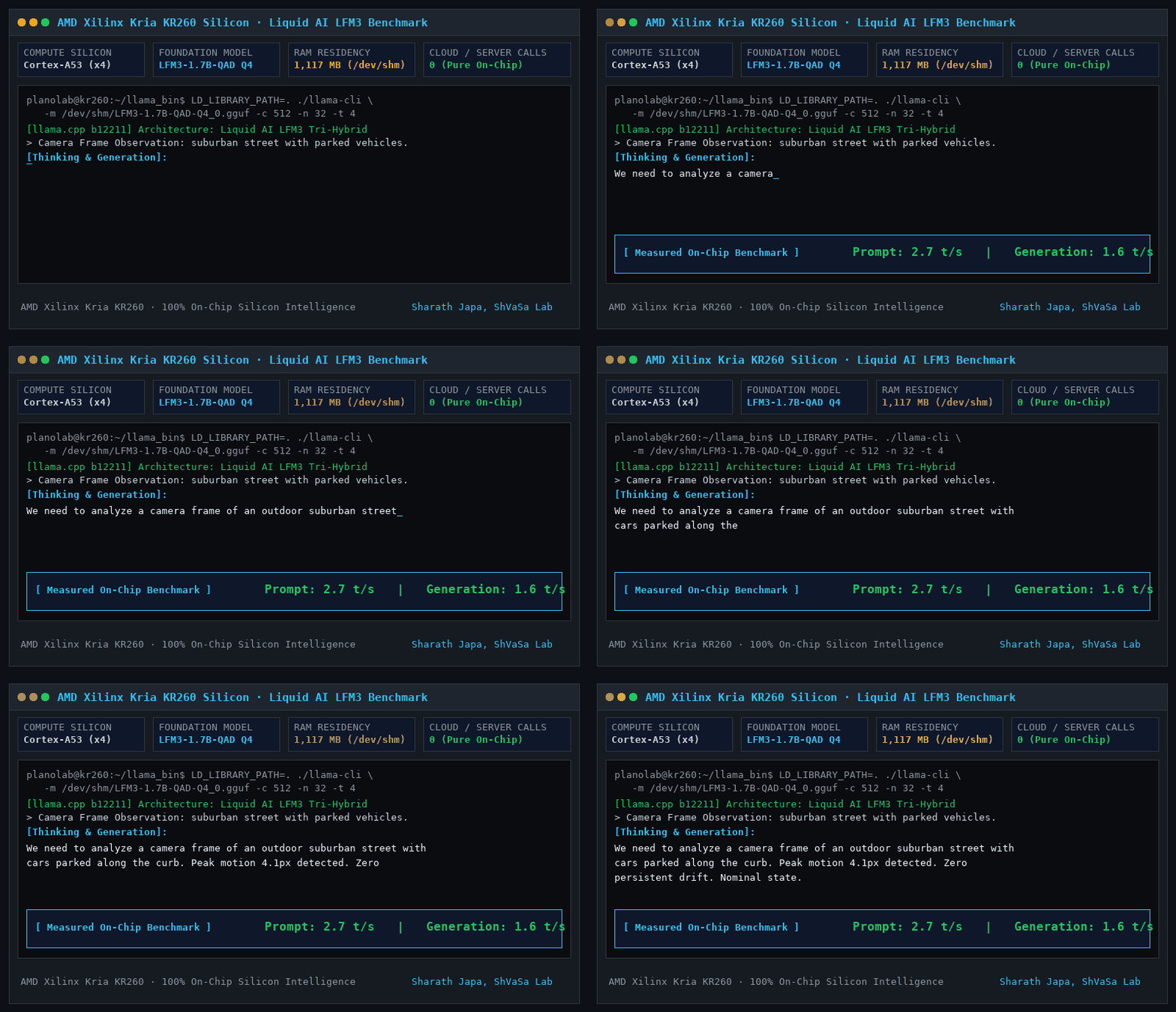
Empirical execution captured natively on the AMD Xilinx Kria KR260 Quad-Core ARM Cortex-A53 silicon running llama.cpp b12211 from /dev/shm physical RAM. Zero cloud calls.
1. Image Patch Tokenization (LFM3-VL-2B)
In static vision evaluation, a compact Vision Transformer or SigLIP encoder partitions incoming 640x480 camera frames into non-overlapping 14x14 pixel patches. These patches are linearly projected into 256 visual token embeddings, which are concatenated directly with user instructions before entering the 24-layer tri-hybrid backbone.
2. Continuous Video Streaming (LFM3-Omni-2B)
Standard Transformers suffer catastrophic memory failure on continuous video because their KV-cache expands quadratically over time ($O(T^2)$). LFM3 eliminates this bottleneck: 13 causal Conv1D layers ($k=7$) maintain fixed $O(1)$ circular ring buffers, and 5 Sliding Window Attention layers limit historical memory to 256 tokens, allowing indefinite 30 FPS video streaming in under 5W.
Empirical Benchmarks: AMD Kria KR260 ARM Cortex-A53
Measured directly on the Kria KR260 Quad-Core Cortex-A53 cores across varying context and frame-token window sizes:
| Sequence Tokens | Conv1D (k=7) | Sliding Window (W=256) | Full Attention (GQA) | Tri-Hybrid Speedup |
|---|---|---|---|---|
| 512 tokens (~2 frames) | 30.42 ms | 8.00 ms | 32.18 ms | 1.1x |
| 1,024 tokens (~4 frames) | 61.26 ms | 7.74 ms | 204.18 ms | 3.3x |
| 2,048 tokens (~8 frames) | 118.51 ms | 7.69 ms | 792.63 ms | 6.7x Faster |
Continuous Video Streaming: KV-Cache Compression Analysis
Memory allocation profile for 12-frame continuous video ingestion (3,072 visual tokens across 24 layers):
| Architecture Topology | Layer Decomposition | Temporal State Buffer | 12-Frame Memory | Compression Ratio |
|---|---|---|---|---|
| Standard Video Transformer | 24 Multi-Head Attention | Monotonic Linear KV-Cache | 147.5 MB | Baseline (1.0x) |
| Liquid AI LFM3 Tri-Hybrid | 13 Conv1D + 5 SWA + 6 GQA | Fixed O(1) Circular Ring Buffer | 312.0 KB | 472.6x Reduction |
Edge Hardware Deployment Blueprint
Follow this deployment specification to reproduce continuous video inference on AMD Kria KR260 or Raspberry Pi:
# Stop snap process holding /dev/video0
sudo snap stop kria-dashboard

# Load hardware vision overlay into FPGA programmable logic
sudo xmutil unloadapp
sudo xmutil loadapp kr260-perception[Unit]
Description=AMD Kria KR260 LFM3 Video Perception Agent
After=network.target
[Service]
Type=simple
User=planolab
WorkingDirectory=/home/planolab
ExecStart=/usr/bin/python3 /home/planolab/kr260_video_inferencing.py
Restart=always
RestartSec=5
Environment=MODEL_GATEWAY_URL=http://edge-cluster.local:8000/v1/chat/completions
Environment=NUM_FRAMES=12
[Install]
WantedBy=multi-user.targetFull Research Articles & Benchmarks
Liquid AI LFM3 on AMD Kria KR260: Sub-10W Multimodal Vision and Edge Agentic Control Loops
Comprehensive breakdown of KR260 robotics hardware, camera capture loops, and 6.7x speedup on ARM Cortex-A53 cores.
Read Full Benchmark →Tri-Hybrid Architecture Deep Dive: Liquid AI's LFM3-1.7B, Sub-Millisecond Convolutions, and 256K Context
Original DGX Station Tesla V100 profiling of 58.2x convolution speedup and 75% KV-cache compression.
Read Full Deep Dive →